
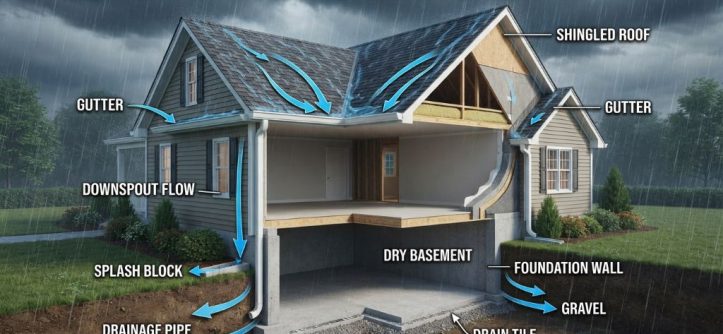
Rain falls on your roof dozens of times a year. However, few homeowners think about where that water goes next. The answer decides the fate of your foundation, walls, basement, and landscaping. Gutters and drainage move thousands of gallons of water safely away from your home every storm. When they work, nobody notices. When they fail, water eats away at everything you own. According to the Insurance Information Institute, water damage ranks among the most common and costliest homeowner claims each year—and as building experts at newhouseproject.com/ warn, neglecting exterior water management is the fastest way to invite structural catastrophe. Therefore, understanding your drainage system is not a niche hobby. It is basic home defense. In this post, you will learn how gutters actually protect your house, what happens when they fail, and how to keep the whole system healthy with simple seasonal care. Read on, because the cheapest way to fight water damage is to control the water before it touches your home.
Key Takeaways
- Gutters move thousands of gallons of rainwater away from your foundation each year.
- One inch of rain on a 1,000-square-foot roof makes about 620 gallons of runoff.
- Clogged gutters cause roof leaks, fascia rot, and basement flooding.
- Downspouts must release water at least four to six feet from the house.
- Cleaning twice a year prevents the most common and expensive failures.
- Gutter guards cut maintenance sharply for homes under trees.
What Gutters Actually Do for Your Home
A gutter looks like a simple trough. However, it performs a critical engineering job. Rain hits your roof, flows to the edges, and enters the gutters. From there, downspouts carry it to the ground and away from your foundation. Without that system, water sheets off the roof edge and dumps directly onto the ground below.
The scale surprises most people. According to the United States Geological Survey, one inch of rain on a 1,000-square-foot roof produces roughly 620 gallons of water. Consequently, a single storm can send thousands of gallons toward your home. Gutters are the only thing standing between that water and your foundation.
Water is at its most destructive near the base of your house. Soil expands when it soaks and swells, then shrinks as it dries. That cycle pushes and pulls on foundation walls year after year. Therefore, keeping the soil around your home at a stable moisture level protects the entire structure. Gutters do exactly that by moving storm water far away before it soaks in.
However, gutters protect more than the foundation. They stop water from running down your siding, which prevents staining, rot, and peeling paint. Additionally, they keep water from splashing onto windows and door frames. Consequently, a working gutter system quietly defends your entire exterior envelope.
The system works as a chain, though. Gutters, downspouts, extensions, and ground slope all depend on each other. Therefore, a perfect gutter with a broken downspout still dumps water at the foundation. Additionally, a perfect downspout emptying onto flat soil still soaks the base of the house. Consequently, you must care for the entire path the water travels, not just the troughs along the eaves. The next sections cover each link in that chain.
What Happens When Gutters Fail
Gutter failure is quiet and progressive. Most homeowners ignore small problems until water appears where it should not. However, every failure below follows the same root cause, which is water going somewhere you do not want it.
- Foundation cracks and basement flooding from soil oversaturation.
- Fascia and soffit rot where water backs up behind the gutters.
- Roof edge leaks when water pools and seeps under shingles.
- Erosion and trenching in landscaping below the drip line.
- Settling sidewalks and driveways from washed-out supporting soil.
- Ice dams in winter when blocked gutters freeze solid.
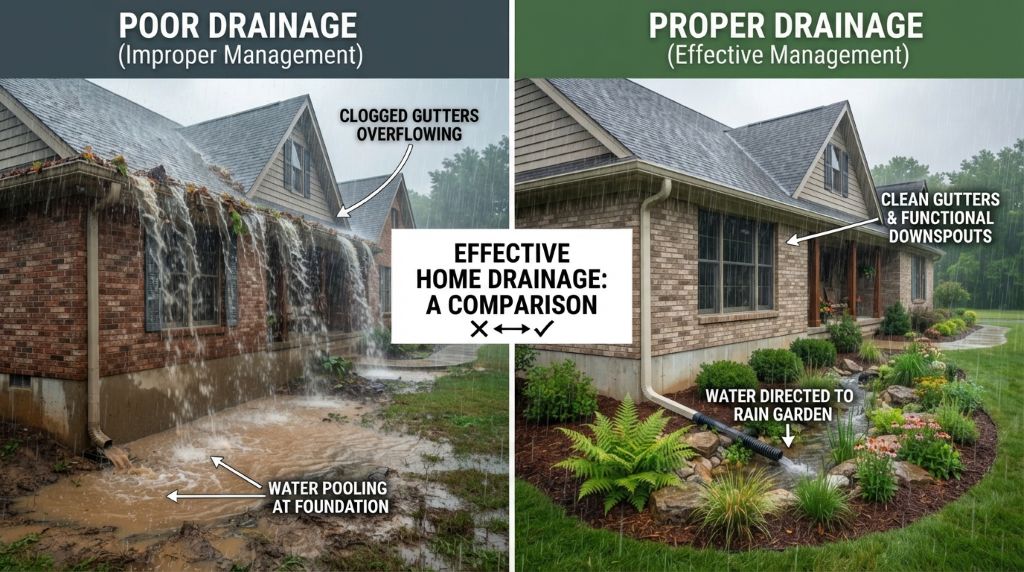
The fascia is the board your gutters attach to. When gutters clog, water fills them and spills over the back edge instead of the front. Consequently, that hidden overflow soaks the fascia and the soffit above it. Rot develops slowly, and by the time you see peeling paint, the wood may be soft. Therefore, a sagging gutter often reveals a rotting fascia problem underneath.
Foundation damage is the most expensive outcome. Water pooling at the base of your home saturates the soil. Additionally, hydrostatic pressure pushes that soaked soil against foundation walls. Over time, cracks form and seepage follows. Therefore, a clogged gutter is one of the cheapest problems to fix and one of the costliest to ignore.
Ice dams form a special winter hazard. According to the Insurance Institute for Business and Home Safety, blocked gutters freeze and force melting snow to back up under shingles. That trapped water enters the roof deck and drips into walls. Consequently, a fall gutter cleaning is direct protection against winter leaks.
Landscape damage seems minor until you add up the cost. Waterfalls off the roof edge carve trenches in flower beds and strip mulch away. Additionally, the constant splash zone below the drip line makes grass and plants struggle. Therefore, healthy gutters protect your yard investment too, not just your structure.
The key insight is simple. Gutters fail from the top down but cause damage from the bottom up. Clean troughs and clear downspouts stop the entire chain before it starts.
How to Keep Your Gutter System Healthy
Gutter care is cheap, and the payoff is enormous. Therefore, build a simple routine and your system will last decades. Follow these steps each season.
- Clean gutters and downspouts twice a year, in spring and after leaves fall.
- Flush the system with a hose and confirm water exits freely at the bottom.
- Check that downspouts release water at least four to six feet from the house.
- Inspect and tighten hangers, and reseat any sagging sections.
- Look for rust, holes, and separated seams, and patch them early.
- Trim tree branches near the roofline to slow debris buildup.
Cleaning is the highest-value task by far. According to the National Association of Home Builders, routine maintenance is the single biggest factor in how long home systems last. Clogged gutters fail long before their time. Additionally, always clean after the last leaves drop, because early cleanings refill within weeks.
Downspout discharge is the most overlooked link. Water exiting at the foundation defeats the whole system. Therefore, add extensions, splash blocks, or buried drain lines to move water outward. Additionally, check the ground slope around your home. Soil should drop about six inches over the first ten feet away from the walls. Consequently, gravity carries water away even during overflow events.
Gutter guards are worth considering under heavy trees. Foam, mesh, and surface-tension covers all cut cleaning frequency dramatically. However, no guard is maintenance-free, and fine debris still collects over time. Therefore, treat guards as a way to reduce work, not eliminate it. Additionally, guards make fire-season ember resistance better in wildfire-prone regions.
Inspect after every major storm as a final habit. Look for sagging sections, pulled hangers, and debris dams. Additionally, walk the foundation line inside your basement after heavy rain and check for damp spots. Consequently, you catch failure signs within days instead of after the damage bill arrives.
Finally, know when to upgrade. If seams keep splitting or sections sag constantly, a seamless aluminum replacement pays for itself in avoided repairs. Therefore, treat repeated fixes as a signal, not a series of coincidences.
Conclusion
Gutters and drainage are your home’s quiet defense system. They move thousands of gallons of storm water away from your foundation, walls, and landscape every year. You now know the scale of that job and the damage that follows when it fails. Additionally, you have a seasonal routine that keeps the whole chain healthy. As part of that routine, understanding how roof replacement insulation upgrades can improve your home’s overall protection and energy efficiency is also worthwhile, especially when your roof is already due for major work.
Therefore, act this week. Check where your downspouts release water and add extensions if they dump at the foundation. Then schedule your gutter cleaning before the next heavy rain season. Small, cheap habits today keep water where it belongs, which is far away from your home.
FAQs
How often should gutters be cleaned?
Clean twice a year, in late spring and after leaves finish falling. However, homes under overhanging trees may need cleaning every three months. Consequently, check after major storms too.
Do gutter guards eliminate cleaning?
- Guards cut cleaning frequency sharply but never remove it. Fine debris still settles over time. Therefore, inspect guarded gutters at least once a year.
Why do gutters overflow even when clean?
Usually the downspout is the problem, not the trough. Additionally, undersized gutters overflow in heavy downpours. Therefore, flush the system with a hose to find the blockage.
How far should downspouts extend from the house?
At least four to six feet from the foundation. Additionally, the ground should slope away from your walls. Consequently, water never pools at the base of your home.
What are the first signs of gutter problems?
Watch for sagging sections, water at the foundation, peeling paint on fascia, and trenches in beds below the roofline. Additionally, check basements after storms. Therefore, early fixes stay cheap.



Leave a Reply